LLMs vs humans: energy, data, and compute
Originally posted as a LessWrong shortform comment.
How do LLMs and humans compare with regards to the amount of energy, data, and compute that’s used to train/run them? I was inspired by Samuel Knoche’s post on sample efficiency to come up with some numbers. This table was made by Opus 4.8. after some iteration:
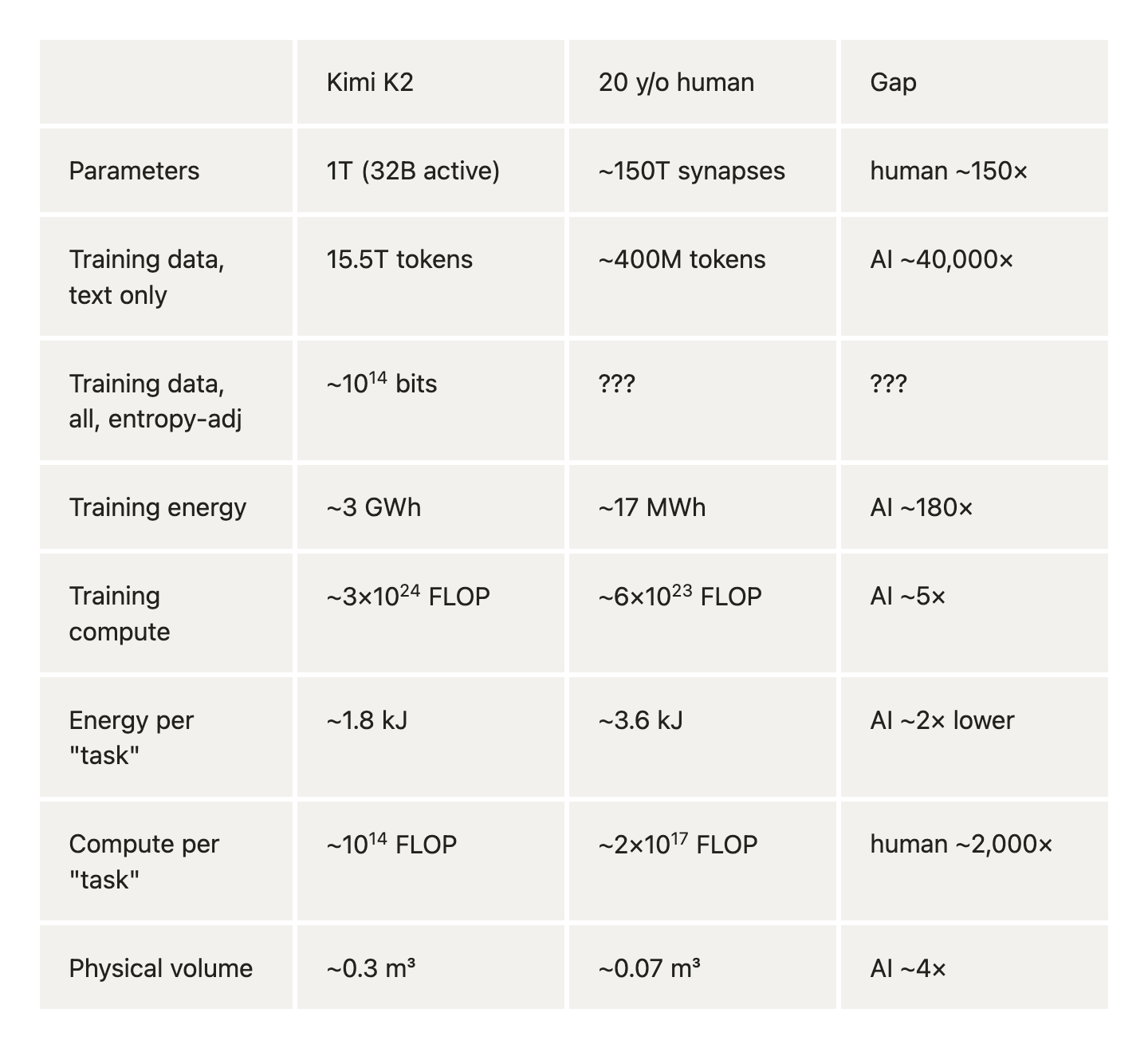
“Task” = “produce one thoughtful ~1,000-token answer”; unclear if this is a useful number, obliviously it doesn’t generalize. I do think it’s interested to compare the energy/computer ratio for inference between human and AI.
Training data for humans is a big ”???”. There’s ~4x10^8 waking hours. Opus 4.8 cited this 2024 paper which says “our sensory systems gather data at ~10^9 bits/s”. That gives ~4x10^17 as an upper bound. But human sensory data is extremely redundant. If someone wants to spend time figuring out a good way to estimate entropy adjusted information here, that would be cool.
(FWIW, I spent a little over an hour on this — I did a fair amount of iteration with GPT5.5, looked a bit myself into a few numbers, and got new instances to do estimates from scratch to see if things lined up.)