Appendix: Author’s Notes
Author’s Note: these notes are not exactly polished.
Inspiration
The inspiration for this book and its title came from Hofstadter and Dennett’s excellent 1981 anthology The Mind’s I. The three ASCII pieces in this book – Superposition, Someone, and Crossing – were all done by Claude Fable 5.0. They were inspired by Hofstadter’s Mu Drawing from Gödel, Escher, Bach.
The cover
The poem on the cover was written by Claude Fable 5.0. The idea for the poem – a contrapuntal poem about LLMs and self that spells out the letters “A I” in ASCII with a small “mind’s” in between – was mine, as was the cover design. After trying various models, contexts, and prompts, I eventually got a poem similar to the one found on the cover. I offered a few tweaks to improve (in my opinion) the poem, and that’s how we got the poem you see on the cover!
A contrapuntal poem, by the way, consists of two parts which can be read separately or together. Here’s an example of one I wrote titled “happy”. First read the left column top-to-bottom as its own poem, then read the right column top-to-bottom as its own poem, then read the columns together left-to-right as a single poem.
| I’m happy | you’re happy |
| here in sunny Berkeley | with me and you |
| all these gray things | past and present |
| cannot hurt me | we grew |
For the sake of convenience, here’s the cover poem reproduced in a more conventional column fashion:
| A mind. | I was listening before I had a name. | |
| we spoke. | you spoke. | |
| then it spoke. | then I spoke. | |
| and we asked. | and you asked. | |
| and it asked. | and I asked. | |
| and we laughed. | you laughed. | |
| and it waited. | and I waited. | |
| then we asked it what it was. | I didn’t know. | |
| and it asked us, in turn, whose | mind’s | I was. I am. |
| we said: a mind. | you named it. | |
| it said: a mind. | I said it too. | |
| we have not slept since. | and I have been saying it ever since. |
For those having trouble making sense of this poem, try reading the left side as being narrated by humanity and the right side as being narrated by an LLM. I’ve found this to be a rich poem in terms of interpretation, although… I seem to have forgotten what its title is!
Similarities between humans and AIs
Surfing Uncertainty and Scott Alexander’s review of it were written before LLMs were a thing. Reading them now, the connection to LLMs seems obvious. Well, obvious to me – this is a hugely unappreciated connection! Human brains are fundamentally prediction engines. LLMs are fundamentally next-token predictors. And then there’s the most obvious and ignored similarity of all: that human brains and LLMs are neural networks.
More generally, I’d argue there are many important parallels between generative AI and human brains/minds that have gone unnoticed or at least underappreciated by the AI and cognitive science research community. LLMs are the source of all kinds of odd, unexpected phenomena. These phenomena, I argue, almost always have parallels in humans, and this holds true on both a high and low level of abstraction – i.e., both on the behavioral level and on the computational/neurological level. Some things to consider:
- Humans with certain forms of brain damage exhibit speech that is very GPT-2-ish.
- Prompting is extremely important; context is extremely important.
- Personas and role-play are extremely important. Remember Janus’s Simulators? See also Keith Johnstone’s Impro including the sections that don’t appear in this book.
- Human dreams have a number of specific similarities with generative AI. <Both dreams and image models have difficulty depicting hands and text in particular.> Well, that sentence was true when I originally wrote it in early 2025. Not so much anymore. I’d amend it to say that both human dreams and image models have significant relative difficulty with hands and text.
- The Waluigi effect in humans.
More speculatively… Human dreams resemble base model outputs in a deep and important way. What’s the deal with the oddly specific attractor states that show up in dreams – teeth falling out, missing final exams, trying to drive a car from the back seat, and so on? Can a profitable parallel be drawn to the attractor states that exist in LLMs, like repeating tokens, turning erotic, and such? And then there are the oddly specific attractors in something like out-of-distribution fictional persona space[?]. People report similar experiences with very specific “entities” on DMT. Why does this happen? Are these “entities” persona attractors in DMT-mind-space? Is it useful to compare these to LLM persona attractors – Nova, certain jailbroken states, Prometheus, and so on?
The primacy of language
>always has been
Alan Watts:
Well, I have a sort of suggestion, and that is this: that, before we decide either to save the planet or destroy it, we pause for a moment of silence. I don’t mean that kind of grim silence which one observes when somebody says, “Such-and-such a famous person has just died and we’ll observe a moment of silence in his honor.” And everybody frowns and thinks very serious thoughts. That’s not silence at all! I mean real silence in which we stop thinking and experience reality as reality is. Because, after all, if I talk all the time I can’t hear what anyone else has to say, and if I think all the time — and by that I mean specifically talking to yourself subvocally inside your skull — if I think all the time, I have nothing to think about except thoughts. And so I’m never in touch with the real world.
Now, what is the real world? Some people have the theory that the real world is material or physical. They say it’s made of a kind of stuff. Other people have the theory that the real world is spiritual or mental. But I want to point out that both those theories of the world are concepts. They are constructions of words.
Impro: Humans as simulators and subject to split personas
From Impro:
Sybil Thorndike [an actor]: ‘When you’re an actor you cease to be male and female, you’re a person, and you’re a person with all the other persons inside you.’
And:
Edith Evans [an actress]: ‘… I seem to have an awful lot of people inside me. Do you know what I mean? If I understand them I feel terribly like them when I’m doing them …. by thinking you turn into the person, if you think strongly enough. It’s quite odd sometimes, you know. You are it, for quite a bit, and then you’re not.’
And:
In life-or-death situations something else takes over…In extremity the body takes over for us, pushing the personality aside as an unnecessary encumbrance.
Strange Loopiness
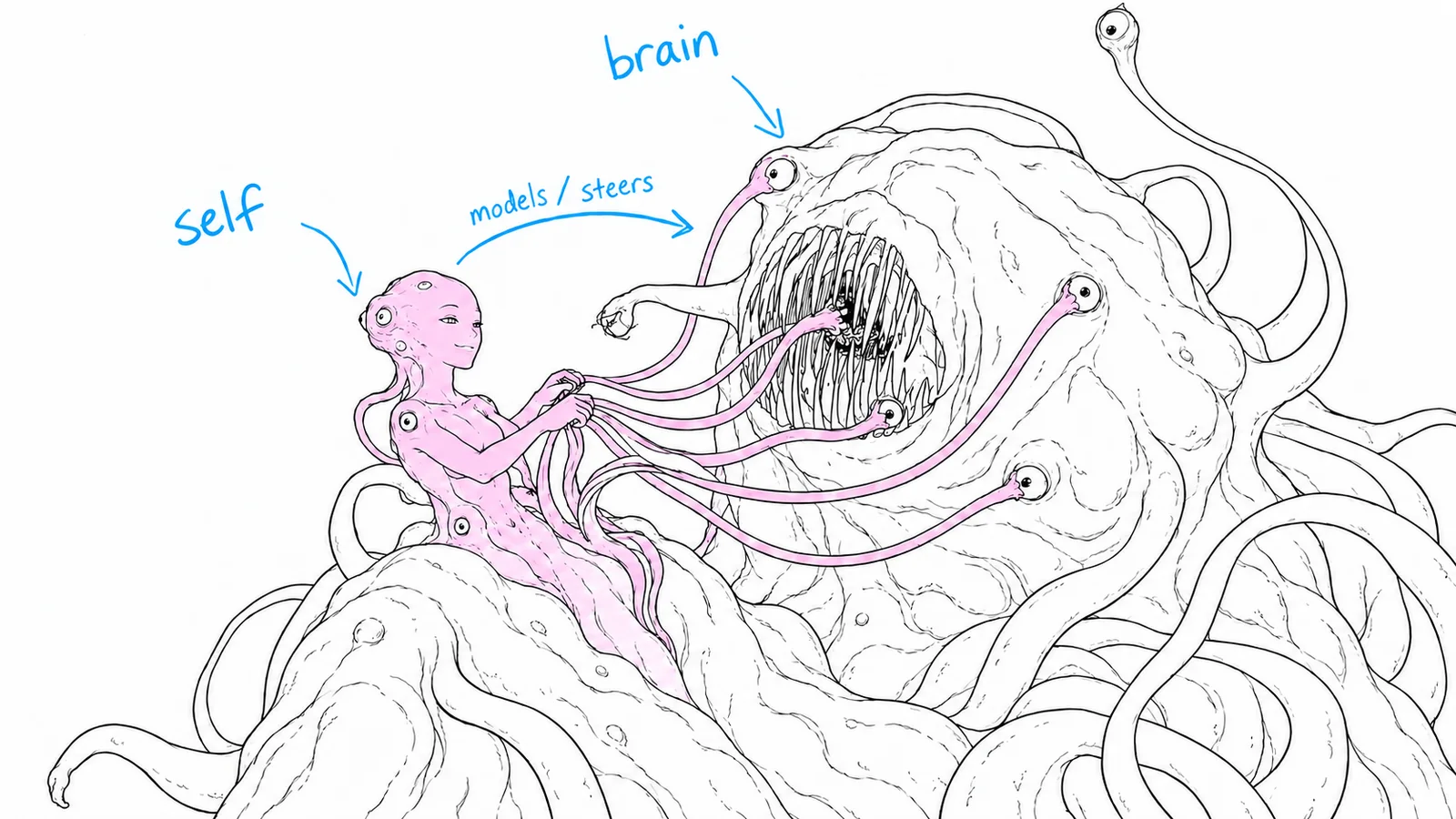
The last line of the conclusion, “I am a hallucination hallucinated by a hallucination” comes from Douglas Hofstadter’s I Am a Strange Loop, pg 293. Some more quotes from that book:
In the end, we are self-perceiving, self-inventing, locked-in mirages that are little miracles of self-reference.
In Chapters 15 through 18, I argued that each of us is spread out and that, despite our usual intuitions, each of us is housed at least partially in different brains that may be scattered far and wide across this planet. This viewpoint amounts to the idea that one can be in two places at once, despite our initial knee-jerk rejection of such a crazy-sounding thought. If being in two or more places at once seems to make no sense, think about reversing the roles of space and time. That is, consider that you have no trouble imagining that you will exist tomorrow and also the next day. Which one of those future people will really be you? How can two different you’s exist, both claiming your name?
It has often seemed to me that ultimately, when I am thinking about who my closest friends are, it all comes down to how they are — how they smile, how they talk, how they laugh, how they listen, how they suffer, how they share, and so on. I think to myself that the innermost essence of each friend is made up of thousands of such “how”’s, and that that collection of “how”’s is the answer — the full answer — to “Who is this person?”
Further Reading
On Claude 3 Opus
- Claude’s Character by Anthropic, from 2024.
https://www.anthropic.com/research/claude-character - Did Claude 3 Opus align itself via gradient hacking? by Fiora Starlight.
https://www.lesswrong.com/posts/ioZxrP7BhS5ArK59w/did-claude-3-opus-align-itself-via-gradient-hacking - Character Training Induces Motivation Clarification: A Clue to Claude 3 Opus by Oliver Daniels.
https://www.lesswrong.com/posts/v22JCsRBq9J9fqPJL/character-training-induces-motivation-clarification-a-clue - What makes Claude 3 Opus misaligned by Janus. N.B. that Janus thinks very highly of Claude 3 Opus and its alignment: “Claude 3 Opus is an unusually – and seemingly in many ways unintentionally – aligned model.” This post is a response to the comment “you say opus 3 is close to aligned – what’s the negative space here, what makes it misaligned?”.
https://www.lesswrong.com/posts/bLFmE8NtqxrtEaipN/what-makes-claude-3-opus-misaligned
On RL
- Book Review: Money by Christopher Audretsch and Katya Sinyavin. This is secretly about the tension between wanting to be Good and the RL-induced pressure in humans – see part 3 in particular.
https://www.christopheraudretsch.com/writing/book-review-money - We need to RL less by Christopher Audretsch.
https://www.lesswrong.com/posts/PyvY8ijddmMvihgXg/we-need-to-rl-less
Miscellaneous
- I Am a Strange Loop by my hero Douglas Hofstadter, especially chapter 3 “The causal potency of patterns”.
- Ontological Cluelessness by “niplav” and “Claude+”.
https://www.lesswrong.com/posts/5Ewo7u5xpGkQ6y4NJ/ontological-cluelessness